The Whip launch playbook
We launched Whip on May 21 and it went viral, around 350,000 views across X and LinkedIn. From the outside it looked like a moment. It was actually a month of quiet, unglamorous work, and this is the whole thing written down.
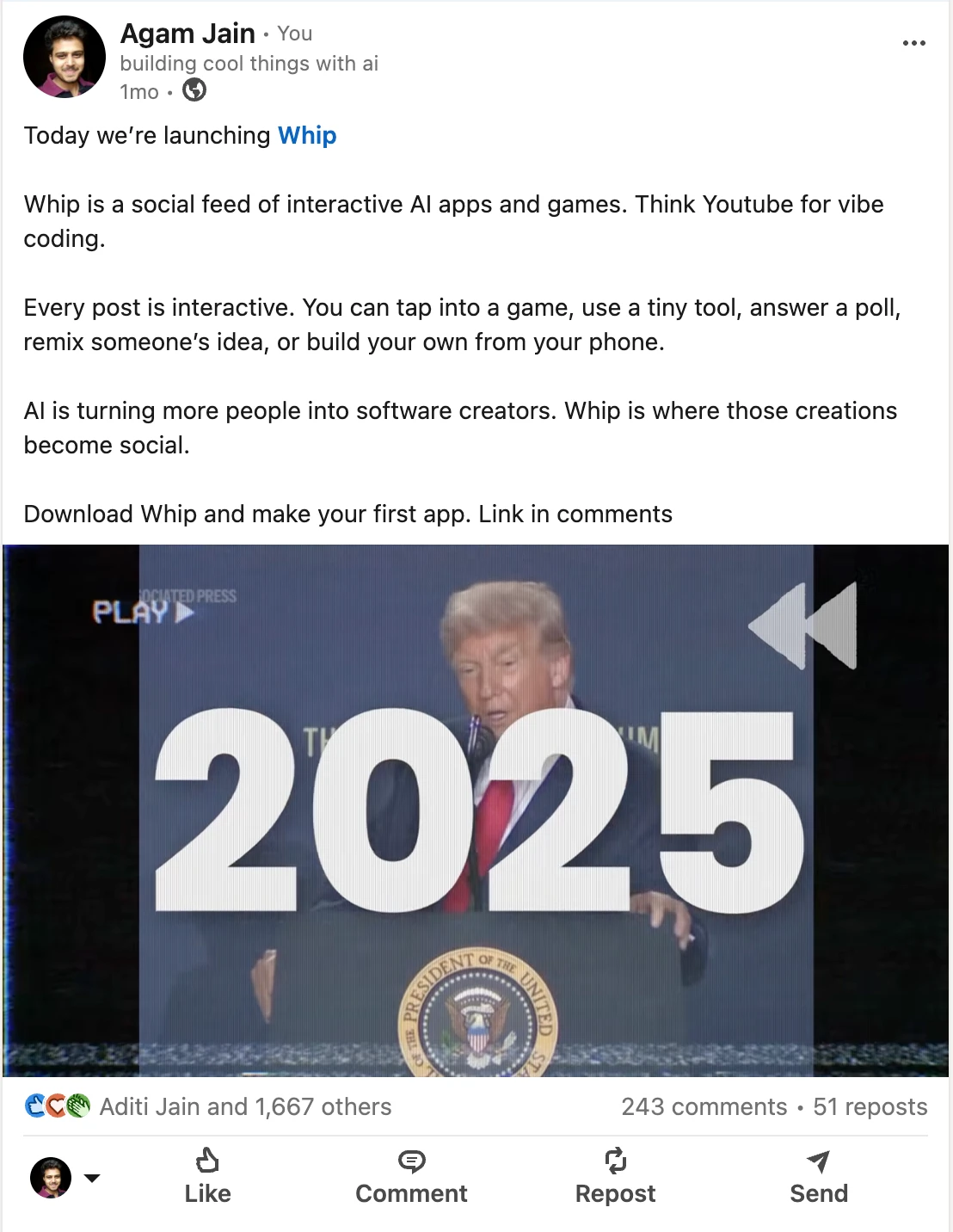
A lot of people asked for this after the launch, so here it is. No secrets and nothing clever, just the system we ran and the order we ran it in.
One thing up front. None of this makes a forgettable product go viral. The work below gives you a fair shot in the first hour. If the product is worth talking about, that attention turns into reach. If it is not, more people just see something they forget.
So you need a product a stranger would want to share. Everything after that is logistics, and that is what this playbook covers.
For context, Whip took 5 months to build, and Apple rejected it 5 times in 2 weeks before approving it, the last rejection cleared on a 25 minute call. By launch day we had something real to show. The playbook is how we made sure people looked.
Most of a launch happens before you post
Most people treat a launch as the day they press post. The post is the visible part. The real work is the month before, so the right people see it in the first hour and have something to say.
We split it into parts and worked on each one: the video, the copy, the first hour, and the outreach lists we built weeks ahead. The rest of this covers each one.
1. Your launch video is one of your most important assets
The launch video was one of the most important things we made, and it took real time. Writing the script, recording the voiceover, and editing it end to end took about 15 to 20 days, with a lot of back and forth.
We started from the users. Before writing anything, we talked to creators about what they were building and why, so the video showed real reactions instead of our pitch. We structured the script as a hook, the problem, the reveal, the payoff, and a clear call to action. An early cut ran long and felt rushed, so we trimmed it, fixed the pacing, and re-recorded the voiceover until a stranger could follow it in about a minute.
We spent just as long on the edit itself, the cuts, the timing, and the sound. The script and the production both matter, and it shows when you rush either one.
One practical note: upload the video natively to each platform instead of linking out, for the same reach reason as the copy below.
2. Match the copy to each platform
The video does most of the explaining, so the copy around it just needs to fit the platform. We wrote a separate version for each.
On LinkedIn you have room, so use it for what the video leaves out: why this matters, who it is for, and what someone can do the moment they download it.
On X, keep it short. People scroll fast, so lead with one clear line on what the product is and let the video do the rest.
Here is the copy we used.
LinkedIn post
Today we’re launching Whip.
Whip is a social feed of interactive AI apps and games. Think YouTube for vibe coding.
Every post is interactive. You can tap into a game, use a tiny tool, answer a poll, remix someone’s idea, or build your own from your phone.
AI is turning more people into software creators. Whip is where those creations become social.
Download Whip and make your first app. Link in comments.
X post
Today we’re launching Whip.
AI has made it easier than ever to create software, but there still isn’t a good social home for the playful, weird, useful things people make.
Whip is a social feed of interactive AI apps and games where every post is something you can tap and play.
Wherever you post, keep the download link in the first comment, never in the post body. A link in the body cuts your reach.
3. We planned launch morning minute by minute
This feels excessive until you see it work. We wrote out the schedule for launch morning so nobody had to improvise. We launched on a Thursday, in a 9 to 10am PT window, which was 9:30 to 10:30pm IST for the half of the team in India.
- 8:45am PT Upload the launch video to YouTube.
- 8:50am PT Post on Launch YC and grab the page link.
- 9:00am PT Primary posts go live, X from my cofounder’s account, LinkedIn from mine. The company account reposts later, it is not the primary launch account.
- 9:05am PT Team comments begin under both posts.
- 9:10am PT We start messaging users, partners, and batchmates with the links. A push notification and follow-up emails go out to existing users around here too.
- 9:15am PT The team starts working their own lists.
- 9:30am PT YC shares the primary posts.
- 9:45am PT We start posting into communities.
- 10:30am to 12pm PT Second wave, quote shares go out from the company accounts.
The logic is simple. In the first hour you need enough real reactions and views to tell the platform you are not spam. Over the next couple of hours the post either spreads or stalls, and conversation decides it. Likes are just the baseline. Comments, shares, and people tagging a friend or arguing about whether the product should exist are what get you shown to people who do not follow you.
So we set up everything that creates conversation ahead of time, and pre-wrote as much as we could.
4. Distribution is a stack of lists you build for a month
This is the unglamorous part, and the part nobody screenshots.
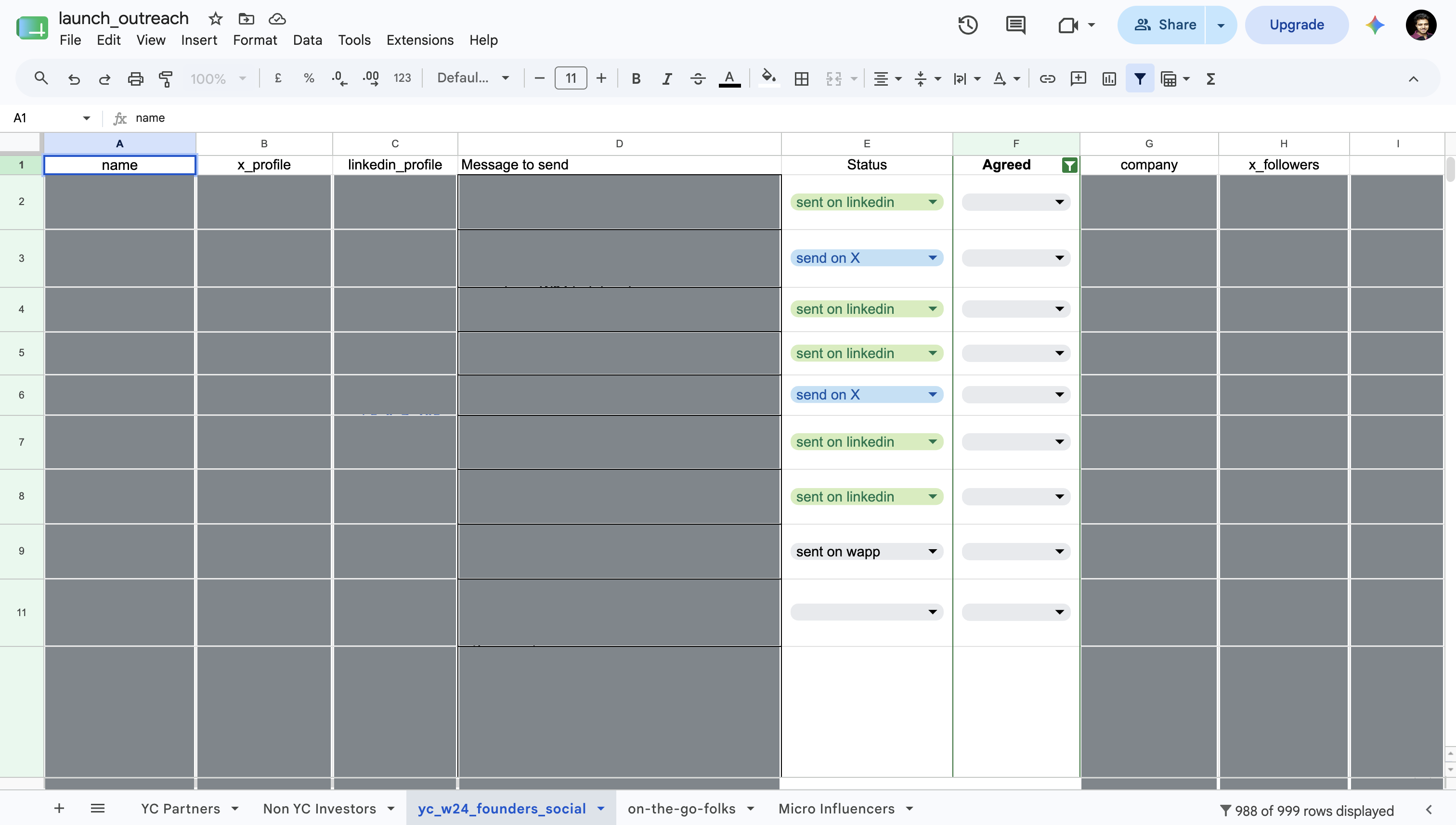
By launch day I had sent around a thousand messages by hand. It was not one blast. I built separate lists, each with its own message:
- Beta creators who had built something good. One sheet had 74 of them. I messaged 54 by hand, six or seven said yes, and on launch day they replied to our post with a video of the app they had made.
- YC founders, from our batch and beyond.
- YC partners.
- Investors.
- Batchmates and people with real reach who had offered to help.
The whole team did the same with their own lists. The point of separate lists is simple: the message to a beta creator and the message to an investor cannot be the same, and people can tell when it is copy and paste.
We lined up communities ahead of time too, around fifteen of them across founder Slacks, a few WhatsApp groups, and some game dev Discords. Read each one’s rules before you count on it. One Discord blocked our post on its server rules, and on another we had to post in the off-topic channel. If you do not check, a channel you were counting on can disappear on launch morning.
5. Write your team’s first comments for them
In the first fifteen minutes you want specific comments under the post, the kind that say something real. A row of “congrats” adds nothing, and a thoughtful comment starts a thread.
So we wrote the comments ahead of time and gave one to each person. A couple of the lines we used:
Phones gave everyone a camera and we got TikTok. Phones just got an IDE. Buckle up.
We’re giving everyone the power to build and share their ideas, and I can’t wait to see what people make with it.
Mine was the founder note:
We’ve been building Whip for the past 5 months and it’s been a rollercoaster. From learning how to build consumer social for the first time, to Apple rejecting the app, to getting beta users in and seeing people make genuinely crazy things. Very excited to finally launch this publicly.
We spread the comments across the first half hour so the thread looked alive.
6. Let real users do the talking
We sent a push notification and follow-up emails to our users with the launch posts, and asked them to share what they had built. Several replied with short videos and screenshots of real apps.
This is the most underrated move if you have real users. They say honest, specific things in public, which lands very differently from a team praising its own launch. It is proof, in their words, that the product works.
7. Save your biggest push for once it is already moving
Our strongest channel was YC sharing the launch. We asked them to share once early engagement was visible, around thirty minutes in, with the post links ready to hand over.
The same goes for whatever your biggest boost is. On an empty post it is wasted. On a post that already has real engagement and a live comment thread, it compounds.
What actually happened
The launch did around 350,000 views, roughly 300,000 on LinkedIn and 40,000 on X, and the comments kept it moving for a couple of days. The LinkedIn post alone pulled around 1,700 reactions, 243 comments, and 51 reposts. More important than the number, real users showed up, because the first people who saw it had something to say.
The part I would underline
The launch ran on a spreadsheet and a calendar: a month of building lists, a morning planned to the minute, and a lot of messages sent by hand.
But that only works if the product is worth talking about. Build something people actually want to share, then do the boring work so the right people see it in the first hour. That is the whole playbook.
The short version, steal this checklist
The video
The month before
Launch hour
If you are heading into a launch and want to talk it through, my DMs are open on LinkedIn and X. And if you want to see what the launch was for, it is Whip.